3D-Printed Medical Exhibits for Trial Attorneys
Your client's actual injury, printed to scale from their own CT or MRI — not a stock anatomical model, not an artist's impression. A physical exhibit a jury, an adjuster, or a mediator can hold in their hands, delivered in days with the documentation your sponsoring expert needs.
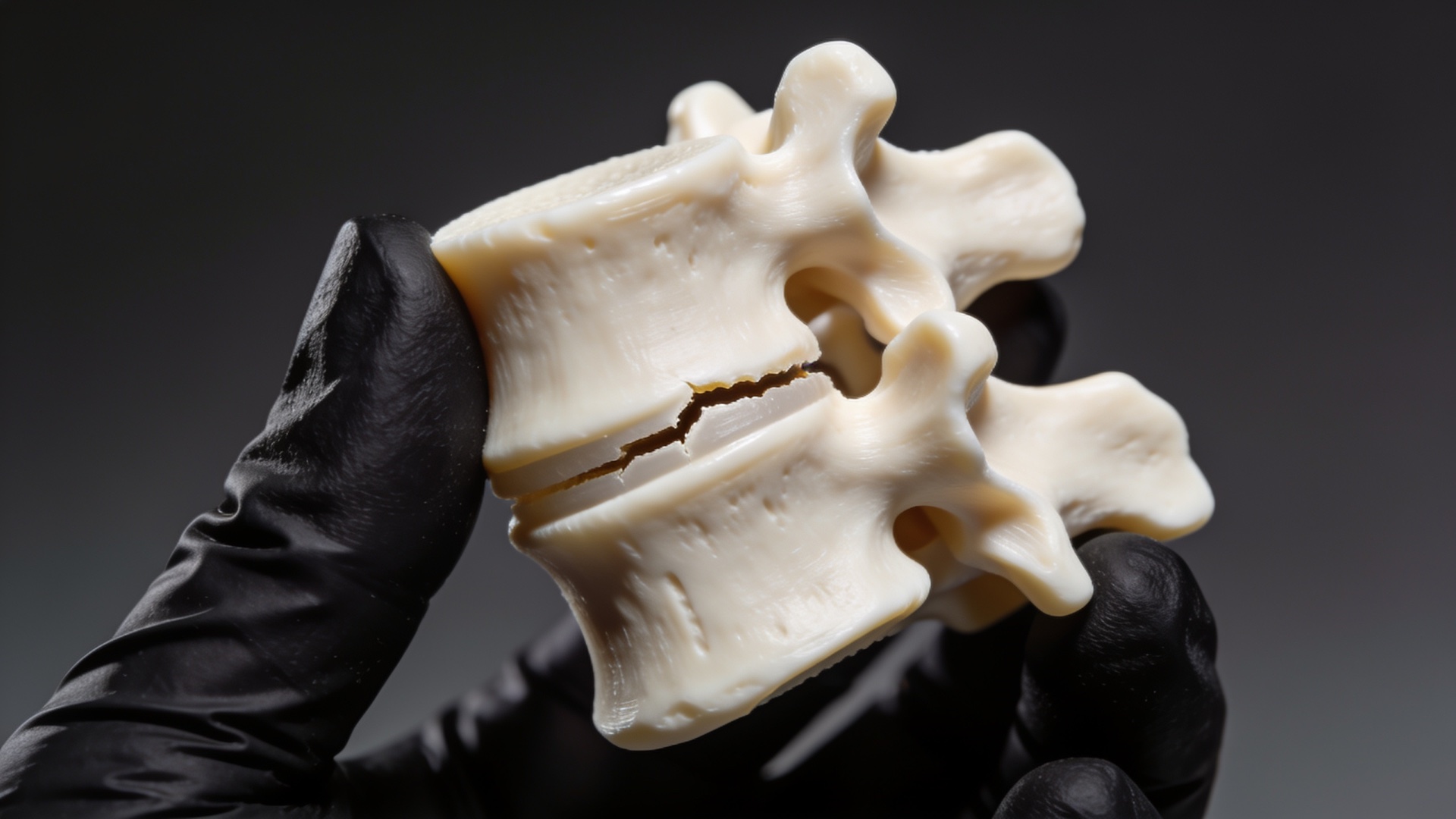
What a 3D-printed medical exhibit is
A 3D-printed medical exhibit is a physical, to-scale model of your client's injury, built directly from the DICOM imaging your firm already has on file — the CT or MRI from the records request. We segment the scan data, model the anatomy, and print it on professional resin printers. The result is demonstrative evidence with a pedigree: every step from scan to print is documented, so the model can be tied back to the client's actual radiology rather than to a catalog part.
That distinction — the client's own data versus generic anatomy — is what separates an exhibit that survives scrutiny from a prop. It's also what lets a treating physician or retained expert testify that the model fairly and accurately represents the scans they've already reviewed.
Why a physical model, not just imagery
Radiology is fluent to physicians and opaque to everyone else. A grayscale CT slice asks a juror or an adjuster to imagine the injury; a printed model lets them hold it. In a peer-reviewed mock-juror study, self-reported comprehension of technical language was higher with 3D-printed models (94%) than with photographs (79%) — a directional finding from a small study, not statistical proof, but it points the same way trial experience does. The same research found physical models less emotionally charged than graphic injury photographs, which is exactly the profile you want when opposing counsel raises a prejudice objection. Read our full admissibility guide for how that plays out under the evidence rules.
What we print
- Fractures — comminution, displacement, and healing hardware shown at true scale.
- Spinal injuries — vertebrae, fusion constructs, and disc-level pathology a jury can rotate in their hands.
- Surgical hardware — plates, screws, rods, and cages in place, making the invasiveness of the repair self-evident.
- Full anatomy and sectioned models — when the mechanism of injury needs surrounding context, dramatic sectioning and injury highlighting focus attention where the case lives.
Where the model wins
In the demand package
Demand-stage negotiation isn't governed by evidence rules — and it's where most case value is actually decided. Photographs of the printed model (or the model itself, across the table) turn an ICD code into an injury the adjuster's committee can see.
At mediation
A mediator who understands the injury pushes the number differently. The model sits on the table for the entire session, doing quiet work every time someone glances at it.
At trial
As a demonstrative aid, the model is typically published through your sponsoring expert — usually the treating physician — who uses it to explain the injury and the surgery. We deliver a documented scan-to-print accuracy chain to support exactly that foundation. Admissibility is always at the court's discretion.
Accuracy you can put an expert behind
Every engagement includes expert-ready documentation of the scan-to-print chain: the source imaging, the segmentation and modeling steps, and the print process. You approve the digital model before anything goes to the printer — and if you have a meeting with the treating physician or a retained expert, we'll join so they can direct edits to the rendering in real time.
HIPAA, handled like a vendor should
Records come to us from your firm, not from the patient. We execute a Business Associate Agreement with your firm, receive imaging over encrypted DICOM upload, restrict access to the production team on your case, and delete or return files per your instruction at close.
Turnaround and delivery
Standard delivery is measured in days, not weeks — we quote an exact date at your consult based on scan quality and complexity. Models ship nationwide, insured and packaged for court. Across Florida, we hand-deliver to your office or the courthouse steps.
Pricing
Each engagement delivers the 3D-printed model and an AI incident-recreation video — most firms run both, the model in the room and the video on the screen. We offer single cases, multi-case packs, and firm retainers for high-volume practices. Every engagement maps to a single line on your case ledger, structured for case-cost recovery — and we quote a fixed price and an exact delivery date at your free consult. Book a consult or read what trial exhibits actually cost.
Frequently asked questions
Is the model built from stock anatomy?
+
No. Every exhibit is printed from your client's own CT or MRI (DICOM) data — the same imaging already in your records file. It is your client's injury, not a generic anatomical model or an artist's impression.
What injuries translate best to a 3D-printed exhibit?
+
Fractures, spinal injuries, and surgical hardware are the classic use cases — anything where geometry matters and imaging exists. Full-anatomy prints and sectioned models are also available when the mechanism of injury needs more context.
Can a jury, mediator, or adjuster actually handle the model?
+
That's the point — it's a physical object built to be held and examined. In mediation and adjuster meetings you control how it's used; at trial, publication to the jury is at the court's discretion.
Do I need an expert to use a 3D-printed exhibit at trial?
+
For trial, foundation is typically laid by a sponsoring expert — usually the treating physician or a retained specialist — who testifies the model fairly and accurately represents the client's scans. We deliver a documented scan-to-print accuracy chain to support exactly that testimony. No expert is needed to use the model in a demand package or at mediation.
Demonstrative aid — admissibility is always at the court's discretion.
Have imaging on file? You're one upload away.
Free consult. We'll tell you straight whether a printed exhibit moves your number — and quote an exact delivery date.